51³Ô¹Ï
Gonzaga’s Jesuit, Catholic, Humanistic education will challenge and inspire you.
Topics in 2026 include weight-loss solutions, psychedelics as treatment for psychiatric disorders, and artificial intelligence in medicine.
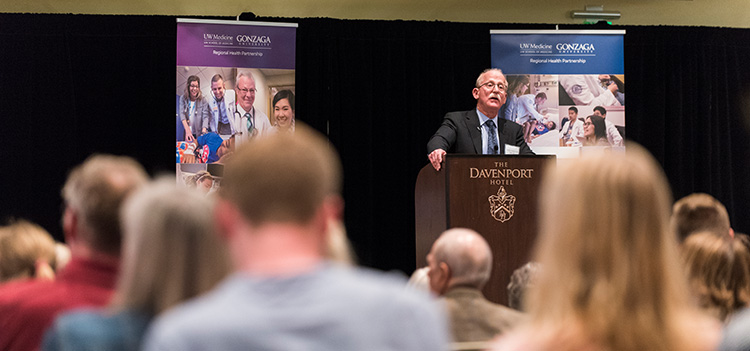
Health care is complex and dynamic. As a result, we are continuously searching for new ways to serve the needs of our 51³Ô¹Ïs and patients in our region. Through a balance of tradition and innovation, and a commitment to improvement, we remain at the forefront of health and medical education. The Next Generation Medicine lecture series is an extension of this promise and was founded by the Health Partnership in 2017. The event is managed by the Next Generation Medicine Committee, a group of communications and events directors and managers, faculty and staff from UWSOM, GU and UW. The Committee handles all logistics for the lectures. Several of our healthcare partners in Spokane sponsor the lectures and have visibility at the events including Inland Northwest Behavioral Health, MultiCare, Providence Health Care, the Spokane County Medical Society, and the Spokane Regional Health District. As information about the next lecture is developed it will be added to this page.
View recordings of Next Generation Medicine events.
Jan 28, 2025
The UW School of Medicine-Gonzaga University Health Partnership Next Generation Medicine lecture series invited Irl B. Hirsch, MD, from the University of Washington, as its winter 2025 speaker on January 28, 2025. Dr. Hirsch is one of the foremost experts on diabetes.
More than 133 million Americans live with diabetes or pre diabetes. 51³Ô¹Ï one third of those diagnosed with diabetes are treated with insulin and could benefit from continuous glucose monitoring (CGM).
Dr. Hirsch's presentation included a history of diabetes management, how CGM technology has evolved, with use expanding beyond individuals with diabetes and new over-the-counter devices.
Jun 24, 2025
Researchers and care providers are struggling to learn how to treat people who have used substances never intended for human consumption.
We're in the "era of synthetics," says Caleb Banta-Green, Ph.D., UW acting professor in psychiatry and behavioral health, and drug epidemiologist. He and Spokane provider Amy Burns, M.D., of Providence Psychiatry will discuss data, intervention, medication, and how the community can help.
Oct 21, 2025
An informative session on how nutrition can impact fertility. Judy Simon is highly regarded clinical nutrition instructor and registered dietician at the Nutrition Clinic at UW Medical Center. As coauthor of "Getting to Baby: A Food-First Fertility Plan to Improve Yours Odds and Shorten Your Time to Pregnancy," she discusses how to fuel for fertility and provide scientifically grounded advice for reproductive health.
October 17, 2024
Nora Disis, MD, a physician-scientist at the UW School of Medicine, was the featured speaker for the Fall 2024 Next Generation Medicine lecture series in Spokane, WA. During her presentation, Dr. Disis shared the latest in her research to develop a breast cancer vaccine that teaches the body’s immune system to recognize and destroy breast cancer cells. Having dedicated her career to learning how the body fights cancer and to developing a breast cancer vaccine, Dr. Disis is confident that such vaccines will become a standard treatment for cancer within the next decade.
April 9, 2024
The Effects of Sleep on Brain Wellness, presented by Jeffrey Iliff, Ph.D., from the University of Washington School of Medicine.
Renowned UW School of Medicine researcher, Dr. Jeffrey Iliff, shares groundbreaking research that demonstrates why getting enough sleep is key for brain wellness, and what you can do to help ensure you're getting the type of sleep your brain needs to function at its best.
Oct. 11, 2023
Learn about the latest research and treatments for Alzheimer's Disease from renowned expert, Thomas Grabowski, M.D., director of the UW Alzheimer's Disease Research Center, and medical director of the UW Memory and Brain Wellness Center. Dr. Grabowski talks about the risks and benefits of the newly approved infusion medication, Leqembi. Silvia Russo, M.D., a cognitive and behavioral neurologist with Providence Medical Group in Spokane joins Dr. Grabowski for the Q&A discussion that follows the lecture.
Irl B. Hirsch, M.D., Professor of Medicine, Diabetes Treatment and Teaching Chair, UW School of Medicine
Panelist: Dr. Carol Weisham, Endocrinologist
May 2, 2023
If you are interested in nutrition, you have likely heard the term, 'gut microbiome', but what is it, and why is it important? Dr. Chris Damman, clinical associate professor of Medicine in the Division of Gastroenterology at UW Medicine shares how our bodies are transformed by bioactive compounds in the foods we eat. He addresses how a new approach to what we put in our bodies is inspiring next generation nutritional approaches to non-communicable diseases.
Caleb Banta-Green, Ph.D., Acting Professor in Psychiatry and Behavioral Health Sciences at the UW School of Medicine, Affiliate Professor at the UW School of Public Health
Panelists: Dr. Amy Burns, Psychiatry at Providence Sacred Heart, Misty Challinor, Director, Treatment Services, Spokane Regional Health District, and Dr. Caleb Holzer, Providence Chewelah Family Medicine Clinic, and Providence St. Joseph Hospital in Chewelah
Drug overdose deaths have reached record highs in the U.S., among teens and adults. One drug that is 50 times stronger than heroin and roughly 100 times stronger than morphine is largely responsible: illicitly-made fentanyl. What is fentanyl? Why has it become so popular? Why is fentanyl such a deadly drug? How can we protect our loved ones and better support the health of our communities? Dr. Caleb Banta-Green, Acting Professor in Psychiatry and Behavioral Health Sciences at the UW School of Medicine, and an Affiliate Professor at the UW School of Public Health, will discuss the answers to these questions and more. He is regularly quoted in national and local news media about drugs, addictions, and their impact, including most recently in The New York Times. Banta-Green is an executive sponsor of Washington State’s Opioid Overdose Response Plan and served as a Science advisor on overdose response to the director of the White House drug policy office.
A special thanks to our partners for helping us bring this event to Spokane: Providence Sacred Heart, MultiCare Spokane, Inland Northwest Behavioral Health, Spokane County Medical Society, Spokane Regional Health District, and the University of Washington Population Health Initiative.
Monica Vavilala, M.D., Director for the Harborview Injury Prevention Research Center (HIPRC), Professor of Anesthesiology and Pediatrics
Kushang Patel, Ph.D., MPH, HIPRC Research Core Director, Research Associate Professor, Dept. of Anesthesiology & Pain Medicine, Adjunct Professor in Gerontology and Geriatric Medicine
The Harborview Injury Prevention & Research Center (HIPRC) is a worldwide leader in injury cause and prevention research. Founded in 1985, HIPRC is affiliated with the University of Washington and Harborview Medical Center, the state’s only Level 1 trauma center, located in Seattle. Presenting at this webinar will be Monica Vavilala, MD, HIPRC director and professor of Anesthesiology and Pediatrics, and Kushang Patel, PhD, MPH, HIPRC research core director, research associate professor in the Department of Anesthesiology and Pain Medicine, and adjunct professor in Gerontology and Geriatric Medicine. During the Q&A portion, the presenters will be joined by Frank Jackson, DO, medical director for Brain Injury at Providence St. Luke’s Rehabilitation Medical Center in Spokane.
Paula Nurius, Ph.D., Professor, School of Social Work, University of Washington
Megan Kennedy, Director, UW Resilience Lab
Panelist: Dr. Amy Burns, Associate Program Director for the Psychiatry Residency program at Providence Sacred Heart Medical Center and Children’s Hospital in Spokane
Vin Gupta, M.D., Affiliate Professor of Health Metrics Sciences at the Institute for Health Metrics & Evaluation
Deborah Fuller, Ph.D., Professor, Department of Microbiology, UW School of Medicine
Panelists: Dr. Gretchen LaSalle, Family Physician at MultiCare in Spokane and vaccine proponent, and Dr. Dan Getz, Chief Medical Officer for Providence Health Care in Spokane
John Lynch, M.D., Associate Professor of Medicine, Division of Allergy & Infectious Diseases, UW School of Medicine, and Head of the UW Medicine COVID-19 Response Team
Panelists: Christa Arguinchona, RN, Program Manager and Coordinator for the Providence Special Pathogens Unit in Spokane, and Dr. Bob Lutz, Health Officer for the Spokane Regional Health District
Ann Browning, Ph.D., Assistant Dean for Well-Being, UW School of Medicine, and Founding Director, UW Resilience Lab
Christine Mac Donald, Ph.D., Associate Professor, Department of Neurological Surgery
Kristie Ebi, Ph.D., Professor, Global Health, and Environmental & Occupational Health Sciences
David Tauben, M.D., Clinical Professor in the Dept. of Anesthesia and Pain Medicine, and Chief of Pain Medicine at the UW
David Tauben, M.D., is a renowned pain expert and University of Washington School of Medicine clinical professor in the Department of Medicine, and the Department of Anesthesiology and Pain Medicine, and Chief of Pain Medicine at the University of Washington. In this lecture, held in Spokane, WA on April 19, 2018, Dr. Tauben presented on The Opioid Epidemic, and how, over the past 20 years, the use of prescription opioid medication to relieve chronic pain has grown at an alarming rate. The opioid epidemic is hitting especially hard in smaller cities and rural communities with fewer resources to deal with this complex problem. He also shared his thoughts on the treatment of chronic pain and what patients need to know.
Matt Kaeberlein, Ph.D., Professor of Pathology
Matt Kaeberlein, Ph.D., is recognized globally for his research on the basic biology of aging. He is a Professor of Pathology at the University of Washington in Seattle. He obtained his Ph.D. from MIT in 2002. At the lecture in Spokane, WA on October 9, 2018, Dr. Kaeberlein presented on Dogs and the Science of Human Aging. The premise of his research is that understanding the molecular mechanisms of aging will lead to interventions that slow the onset and progression of age-related chronic conditions, such as cancer, diabetes, kidney disease, heart disease, Alzheimer’s and others. These common human ailments are also associated with similarly high levels of occurrence in our aging canine companions. Researchers have found significant similarities in how age affects disease risk in humans and dogs, and are on the cusp of learning how to increase longevity in both dogs and their people.
Nora Disis, M.D., Associate Dean, Translational Health Science, Professor of Medicine
Nora Disis, M.D., Fel. ’93, is a renowned UW Medicine cancer researcher and UW School of Medicine associate dean for translational science, and directs the UW Medicine Tumor Vaccine Group, the largest academic research group dedicated to the development of cancer vaccines in the United States. Dr. Disis’ work is at the forefront of bringing laboratory discoveries into clinics and classrooms. In this lecture, held in Spokane, WA on September 14, 2017, Dr. Disis presented on Vaccines to End Cancer, and spoke about how next generation medical research at the UW is uncovering how the body’s immune system can be employed to fight cancer.