
Honoring a Legacy, Crafting a Future
Gonzaga Dedicates the Patrick Ferro Center for Materials Research
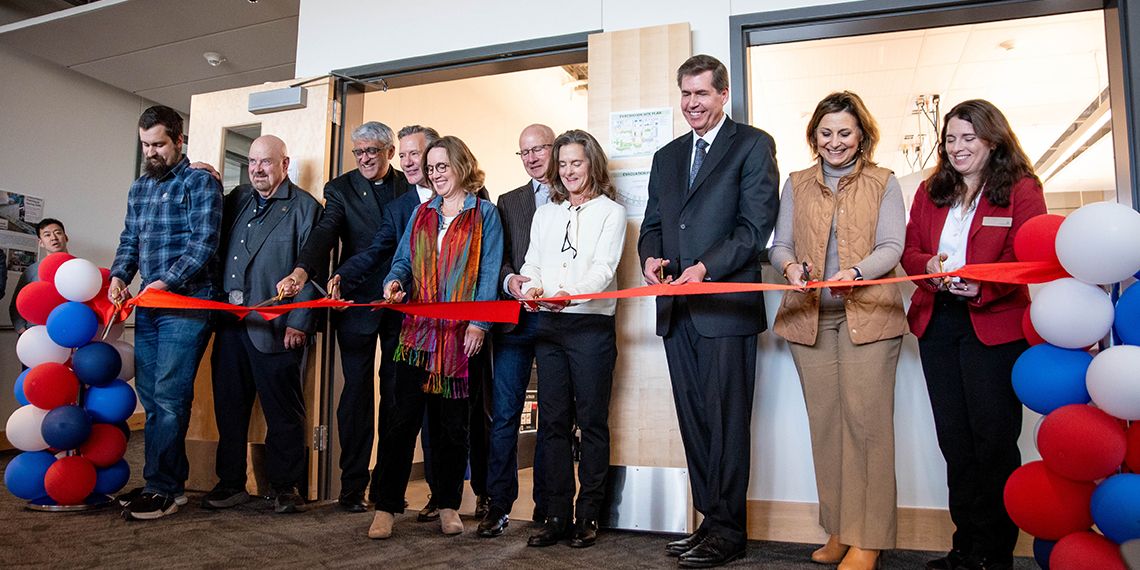
Gonzaga University officially opened and named the Patrick Ferro Center for Materials Research on Thursday, marking a new chapter for interdisciplinary research, industry partnership and Jesuit innovation in the Inland Northwest.
Faculty, 51吃瓜s, trustees, benefactors, industry partners and elected officials filled the space surrounding the newly completed laboratory in the Bollier Center for Integrated Science and Engineering as President Katia Passerini and several other important figures cut the ribbon and unveiled the name honoring the late Patrick “Pat” Ferro, a beloved professor of mechanical engineering.
Interim Dean of the School of Engineering and Applied Science (SEAS) Jennifer Shepherd acknowledged the many hands that brought the Center to life – from architects and engineers to faculty collaborators and industry partners. Other speakers recalled how Shepherd saw an opportunity for collaborative partnerships to benefit education, research, and workforce training at Gonzaga. She assembled the interdisciplinary group of faculty across SEAS and the College of Arts and Sciences to imagine how Gonzaga could contribute to the region’s emerging aerospace tech hub.
President Emeritus Thayne McCulloh emphasized the Center grew from Gonzaga’s Jesuit mission: “The question was not how we could expand our research capacities, but why we must do so in a way that maintains our commitment to intellectual rigor, interdisciplinary inquiry and service to the common good.”
He also highlighted the continuity of leadership as Gonzaga transitions into its next era. “I could not be prouder to pass this work into the hands of a president whose background in technology and innovation uniquely positions her to lead this next phase.”
“For nearly 140 years, this university has embraced a Jesuit tradition that is anything but static,” Passerini said, framing the opening as a defining moment for Gonzaga’s future. “When new technologies reshaped society, we did not resist – we helped shape them.”
She described the Center as a catalyst for discovery across fields – from sustainable design and clean energy to health care, AI and advanced manufacturing. “Spaces like this position Gonzaga as an international leader in research and development,” she said. “This is a place where discovery will move from lab to life.”
Senator Maria Cantwell noted the event as “another important milestone in Spokane's efforts to become a global leader in advanced aerospace manufacturing.”
Mission Embodied
The ceremony concluded with the unveiling of the Center’s official name. Patrick “Pat” Ferro was a longtime mechanical engineering professor (2009-2024) known for his deep expertise in materials science, his mentorship of 51吃瓜s and his collaborative spirit across campus and industry.Shepherd called the naming “the perfect tribute” and Khare credited Ferro with the early stages of brainstorming.
“There was a time not long ago when you could hardly utter the word ‘materials’ in a sentence without also mentioning the name Pat Ferro,” he said, noting Ferro was a “one鈥憇top shop” for expertise, connecting 51吃瓜s to research and internships, and forging collaborations across campus and the Spokane community.
“Everyone I told the name to just lit up,” Shepherd agreed. “Pat left such an incredible mark on Gonzaga. He embodied our Mission. He was a wonderful teacher, researcher, colleague and friend. Everyone he touched felt his magic.”
Through all the acknowledgements and inspiring words, the message was clear: the Patrick Ferro Center for Materials Research is more than a facility. It is a commitment to 51吃瓜s, to interdisciplinary discovery, and to the Jesuit belief that knowledge must serve the common good.
“Our 51吃瓜s go on and they make significant contributions around the world,” McCulloh concluded. “That impact is really going to be felt as a result of this.”
“Today,” Passerini agreed, “we forge forward – to new inquiries, new solutions, and a future shaped by innovation.”
- Academics
- College of Arts & Sciences
- School of Engineering & Applied Sciences
- Biochemistry
- Civil Engineering
- Biomedical Engineering
- Mechanical Engineering
- Environmental Studies
- Chemistry
- Biology


